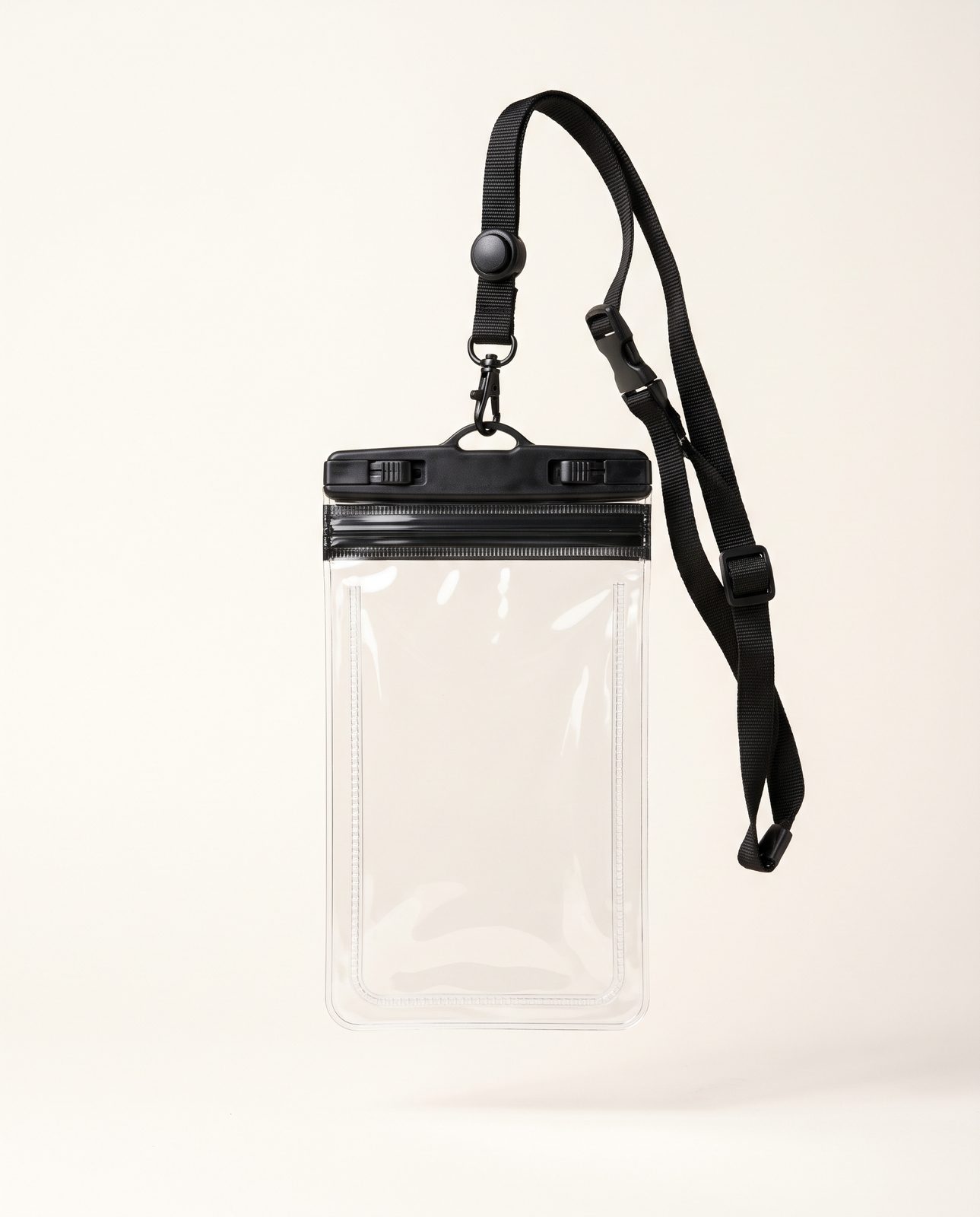
A waterproof phone pouch guide should start with the honest part: this €25 item decides whether you come home with holiday photos or a repair bill. The rating is where it gets confusing. IPX8 sounds absolute, but it only means the manufacturer tested the pouch at a depth and duration they chose. Most pouches are tested to 1.5 m for 30 minutes, which covers swimming but not a 5 m dive.
Below is what those numbers actually promise, how the seal fails in practice, and the two-minute bowl test we run before trusting a new pouch with a phone.
IPX8 in plain numbers
An IP rating has two digits. The first is dust: 6 means dust-tight, X means untested. The second is water: 7 covers temporary immersion up to 1 m for 30 minutes, and 8 covers immersion beyond 1 m under conditions the maker specifies. A pouch marked IPX8 with no further detail tells you almost nothing until you read the small print.
Look for a stated depth and time — 1.5 m for 30 minutes is common — and treat that as a ceiling, not a target. Pressure rises quickly: at 2 m the pouch feels roughly twice the squeeze of 1 m, and a seal that held in the sink can fail at the bottom of a pool.
How the seal works, and how it fails
Most pouches use two closures in series: a zip-lock track you press shut, then a fold-over flap secured with Velcro or a clip. The plastic film is usually TPU around 0.2 mm thick. The design is sound; the failure is almost always contamination in the track.
A single grain of sand is 0.5–1 mm across, and one lodged in the zip track holds the two lips 1 mm apart for the whole length of the seal. Sunscreen, salt crystals and a folded corner of the flap do the same. Before every closure, wipe the track with a clean cloth and check it against the light.
Touchscreens and cameras through the film
Capacitive screens work through 0.2 mm of TPU, so tapping, typing and scrolling all behave normally. Two things do not: fingerprint sensors under the screen often fail, and face unlock struggles when water beads sit on the film. Set a PIN before you go, and expect to type it wet.
For photographs, press the lens flat against the window and shoot through it rather than holding the pouch at arm's length. Skip the flash, which reflects off the film, and wipe the window with a microfibre cloth — a smear of sunscreen turns every sunset shot into a soft orange blur.
Heat does more damage than water
A pouch left on a car dashboard in Spain reaches 60 °C or more, and the adhesive holding the window to the frame softens well before that. We have seen windows lift at the corners after one afternoon in a hot car — still watertight for a splash, useless for a swim.
Keep the pouch in the shade, and never leave it in a towel bag on the sand at midday. Also rinse it in fresh water after saltwater use: dried salt crystals abrade the track every time you open it, and they scratch the window from the inside. A pouch that has spent a week in a hot car is worth testing again before you swim with it.
Test it in a bowl before you trust it
Before the first trip, put a folded tissue inside, seal the pouch exactly as you would at the beach, and submerge it in a bowl of water for 30 minutes with a mug on top to keep it down. Dry the outside, open it, and check the tissue. If there is any dampness, return the pouch rather than risk a phone.
Repeat the test at the start of each summer. Seals weaken with UV and with the 20 or so openings a two-week holiday involves. We replace a pouch after two seasons of regular use, or sooner if the window is visibly scratched.
Waterproof phone pouch guide: what we carry
Our own kit is deliberately boring: a 20 × 12 cm pouch with a double closure, a lanyard long enough to go over the shoulder, and a small float strap for boat days. A phone plus pouch weighs about 220 g and sinks without hesitation, so the float is not a gimmick.
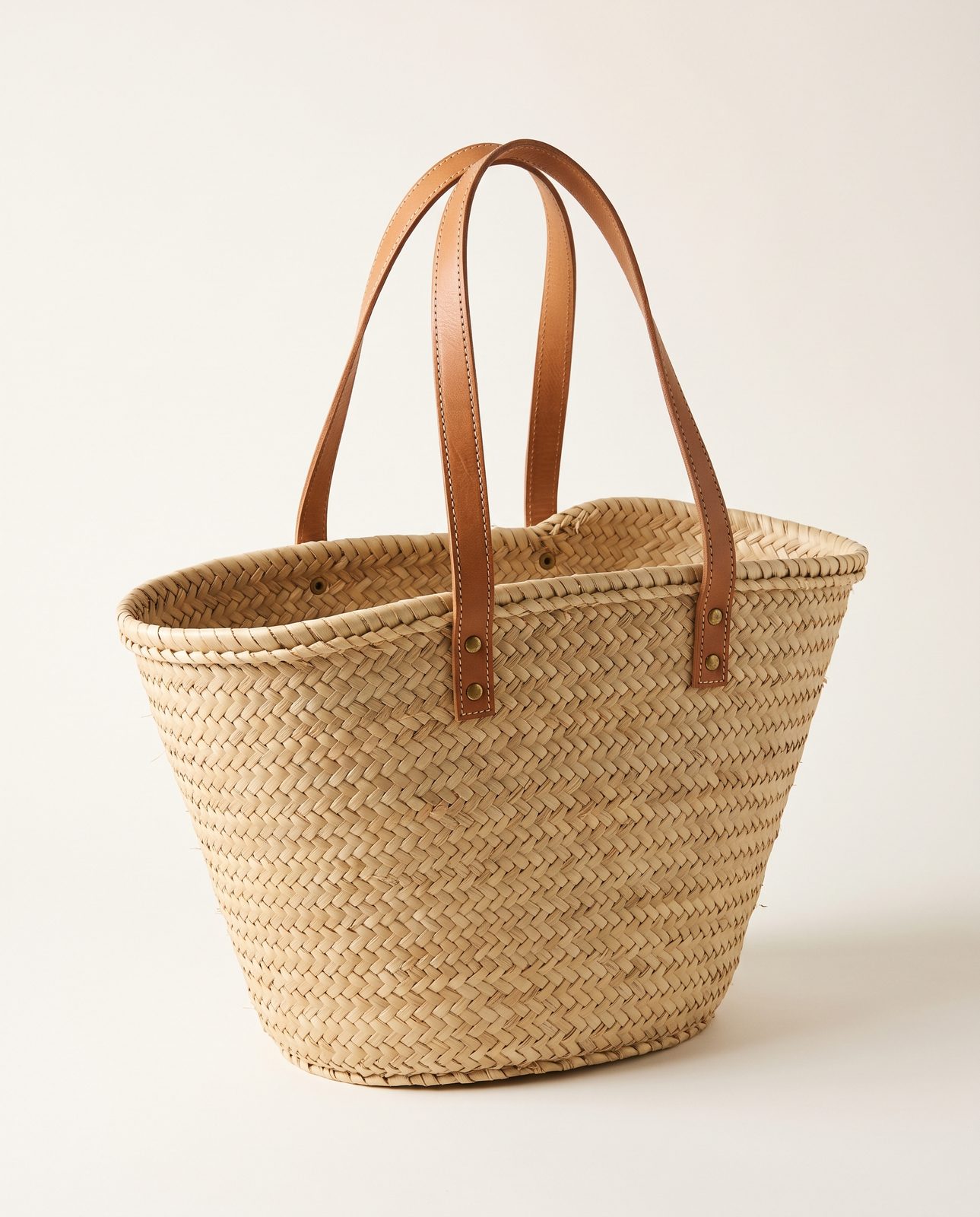
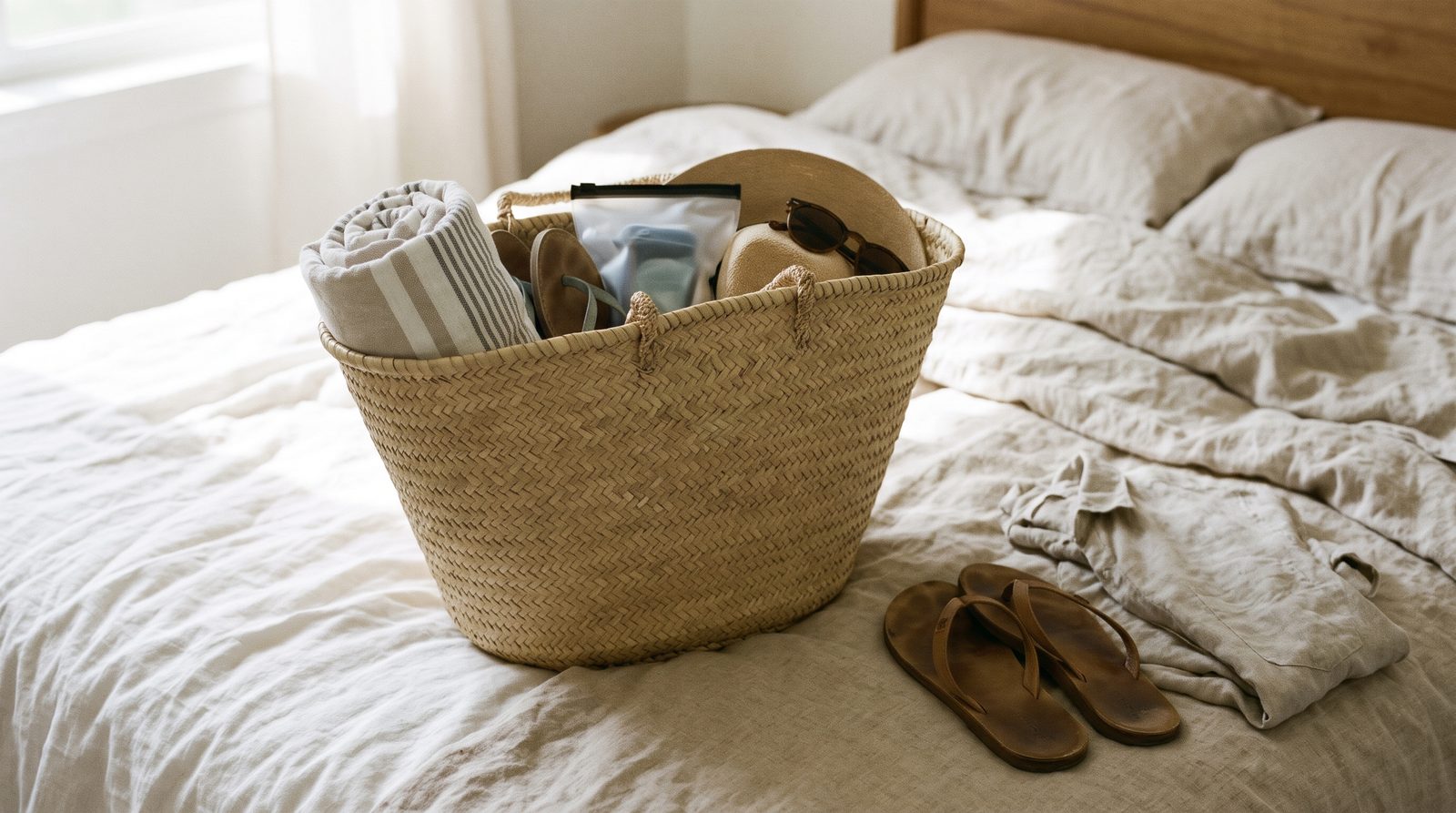
We carry the pouch inside the straw beach tote rather than dangling it, and clip the lanyard to a zip pull so it cannot slide out on the walk back. Total cost is less than a single screen repair, which is the only comparison that matters.
- Stated depth of at least 1.5 m for 30 minutes
- Double closure: zip track plus fold-over flap
- Window at least 0.2 mm TPU, unscratched
- Lanyard plus a separate float strap
- Rinse in fresh water after every saltwater day
Frequently asked questions
Can I take photos underwater with a phone pouch?
Yes, to about 1 m, which is enough for snorkelling shots in clear water. Press the lens flat to the window, use the volume button as a shutter, and skip the flash. Colour drops off quickly below 2 m, so stay shallow.
Does Face ID work through a waterproof pouch?
Rarely, especially with droplets on the film. Set up a PIN and use the on-screen keypad instead. A fingerprint reader under the screen usually fails too, since the film adds a layer the sensor was not calibrated for.
How often should I replace a phone pouch?
Every two seasons of regular use, or immediately if the window is scratched or the track no longer snaps shut cleanly. They are inexpensive enough that replacing one is cheaper than a single repair.
Is IPX8 good enough for snorkelling?
Usually, if the stated rating is 1.5 m for 30 minutes and the seal is clean. Snorkelling rarely takes a phone below 2 m, but the pressure at the end of a dive is where a tired seal gives way. Test the pouch first and keep it on a float.